In these days of moral ambiguity and intellectual uncertainty, logical puzzles are one of the last non-trivial areas where we can say things with certainty.
None of these puzzles is easy. If you solve all them then you are probably a genius. Some have been the subjects of papers and recent debates in philosophical journals. These puzzles are more than just amusing ways to challenge the gray matter. They show us how easily our thinking goes astray, in particular, how often we make unwarranted assumptions. They give us useful warnings and sharpen our mental skills. A deceptively simple problem, such as the two envelope paradox, shows how easily we can reach a wrong conclusion. This and other paradoxes suggest that there may be many times when we think things through, apparently with sufficient care, but arrive at the wrong conclusion.
The solutions illustrate some important principles of logical reasoning.
The raven paradox is still the subject of scholarly debate. I posted the correct answer in January 2023, replacing an incorrect answer I posted in April 2022.
Why does the moon appear larger when near the horizon? This illusion still baffles the boffins. Written and posted in November 2013.
Why does the number 1 occur as the first digit 6.5 times more often than 9 in data as varied as electricity bills, lengths of rivers, and rotation rates of pulsars? Benford's Law.
How to cross the bay without sexual pecadillos puzzle.
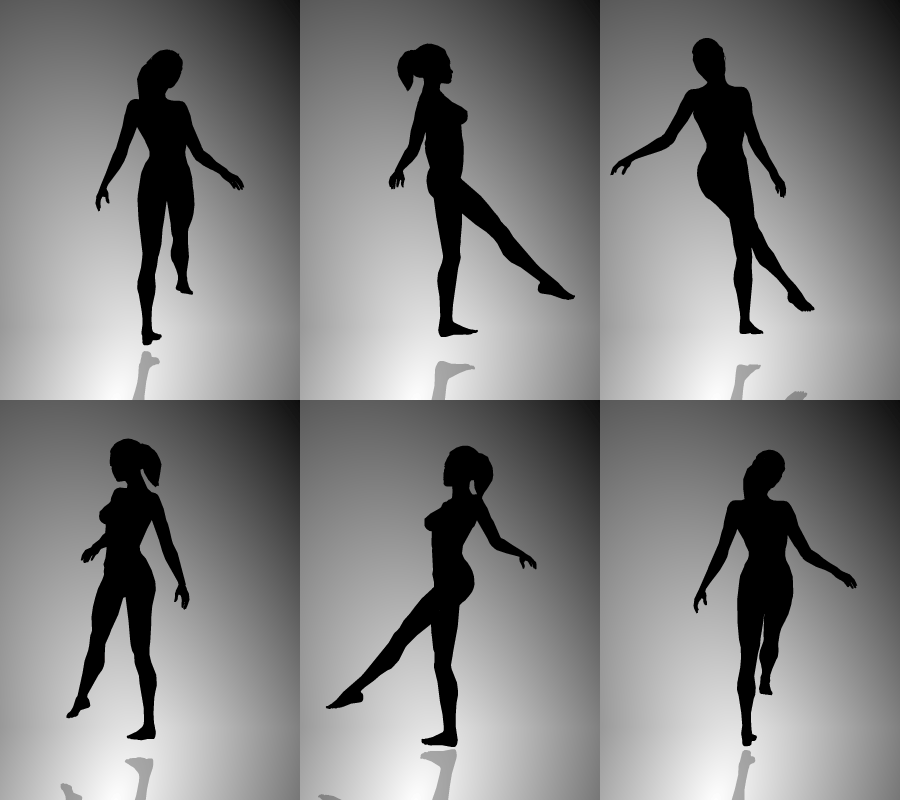
How do we explain the puzzling image at the right? Some people think she is rotating clockwise, others are equally convinced it is anticlockwise. If you look long enough you may find that her direction of motion reverses. See wikipedia.
 In these days of moral ambiguity and intellectual uncertainty, logical puzzles are one of the last non-trivial areas where we can say things with certainty.