Origin of Yahweh
(possibly around 1300 BC) Yahweh was an ancient Semitic deity in the southeastern ancient Levant that became the national god of the Iron Age kingdoms of Israel-Samaria and Judah. The worship of the deity goes back to at least the early Iron Age and apparently to the late Bronze Age, ie around 1300 BC. The oldest plausible occurrence of Yahweh's name is in an Egyptian inscription at Soleb from the time of Amenhotep III (1390–1352 BC).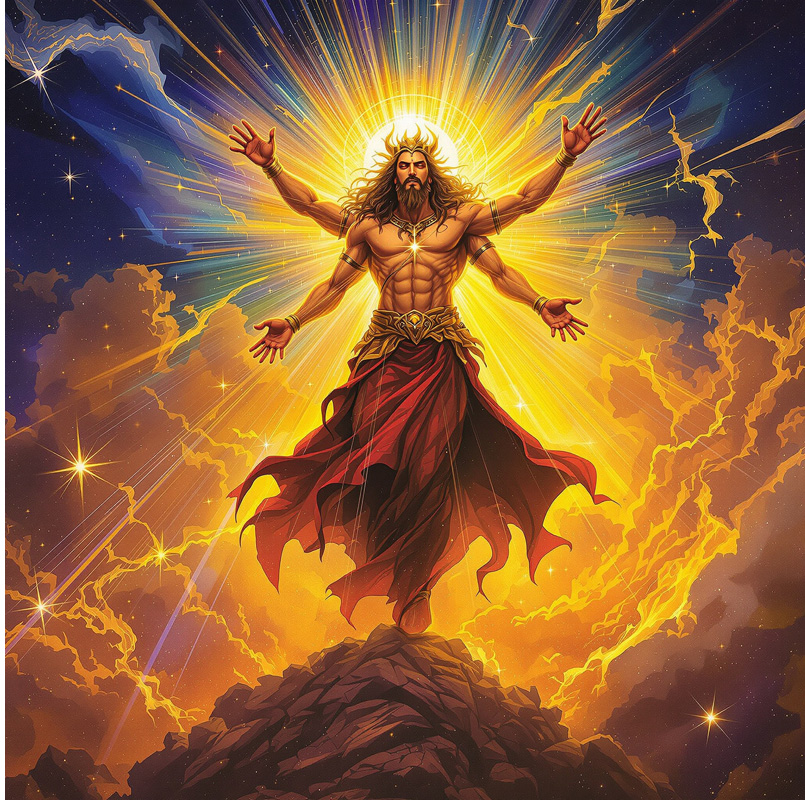 In the oldest biblical texts, Yahweh is the god of weather and war, fructifying the Land of Israel and leading a heavenly army against the enemies of the Israelites. In common with others in the region, the early Israelites were polytheists. The Israelite religion was a derivative of the religion of Canaan (Palestine) and included some of its deities, such as El (who goes back to circa 2800 BC), Asherah, and Baal. Yahweh became conflated with El in later centuries, taking his place as the head of the pantheon in the Israelite religion. Deities, such as Asherah (El's consort) and Baal, were also absorbed into Yahweh.
Michael Coogan wrote "Many biblical writers frequently used polytheistic concepts, depicting Yahweh as the head of a large pantheon whose members advised him and celebrated his accomplishments. This pantheon functioned, as in Mesopotamian and Greek religion, as a kind of divine council or assembly, under the rule of the high god."
A struggle emerged between those who believed that Yahweh alone should be worshipped, and those who worshipped him within a larger group of gods. The Yahweh-alone party ultimately triumphed. Some scholars date the start of widespread monotheism to the 8th century BC, and view it as a response to Assyrian aggression.
In the national crisis of the Babylonian exile, Yahweh is described as the sole deity and absorbs all attributes of previous gods and goddesses. The notion of Yahweh as a supreme deity is described in the 6th-century BC Second Isaiah. The author's praise for Yahweh is motivated by restoring Israel's confidence into their own historical gods against the deities of their Babylonian enemies. The claim for monotheism is directed against the deities of Nebuchadnezzar II, who founded his reign on Marduk and Nabu. The transition was a gradual one and was not totally accomplished during the First Temple period (1000-586 BC).
As Yahwism eventually developed into Judaism, and transitioned from polytheism to monotheism, the existence of other deities was denied outright and Yahweh was proclaimed the creator deity and the only god worthy of worship.
Judaism
(6th century BC) The consensus is that Judaism emerged out of Yahwism when the latter became a monotheistic religion. The Torah, the first part of the Hebrew Bible, was probably written in the 6th century BC.Traditionally, Judaism holds that God—that is, the God of Abraham, Isaac and Jacob, and the national god of the Israelites—delivered them from slavery in Egypt, and gave them the Law of Moses at Mount Sinai as described in the Torah. Jews believe in a monotheistic conception of God characterized by both transcendence (independence from, and separation from, the material universe) and immanence (active involvement in the material universe). God is seen as unique and perfect, free from all faults, incorporeal, and is believed to be omnipotent, omnipresent, omniscient, and unlimited in all attributes, serving as the sole creator of everything in existence. God has no bodily form, is neither male nor female and exists beyond the limitations of time and space.
God is perceived as both just and merciful, interested in each individual, and has established a covenant with the Jewish people. The covenant is a binding, sacred agreement between God and the Jewish people, serving as a cornerstone of faith. It defines a relationship of mutual loyalty, where God provides guidance, protection, and the Land of Israel, while Jews agree to follow God's laws. The covenant defines Jews as a distinct, "chosen" people, not for privilege, but for a special responsibility to live in a way that demonstrates the one God to the world. In contemporary Judaism, the covenant is seen as a living commitment to "repair the world", where humans are partners with God in perfecting the world, rather than waiting for miracles.
Traditional interpretations of Judaism generally emphasize that God is personal yet also transcendent and able to intervene in the world, while some modern interpretations of Judaism emphasize that God is an impersonal force or ideal rather than a supernatural being concerned with the universe. The traditional view is that God is wholly incomprehensible and therefore impossible to envision. Of God nothing can be said at all, and no thought can reach there. Jews believe that "God can be experienced" but also that "God cannot be understood", because "God is utterly unlike humankind".
In modern Judaism, God is seen as the source for one's standards of morality, guiding humanity through ethical principles. One loves and worships God through living ethically and obeying His moral law: "love of God is love of morality."
Most of classical Judaism views God as a personal god and as a national god, meaning that individual humans and the nation of Israel both have a relationship with God.
Christianity
(1st century AD) Christianity originated in the 1st century AD as a Jewish sect in Roman Judea, based on the life, teachings, death, and believed resurrection of Jesus of Nazareth, a Jewish preacher. Followers believed Jesus was the Messiah promised to the Jews. St Paul spread his message of the Kingdom of God throughout the Roman Empire after Christ's crucifixion circa 30 AD.According to historian Shaye Cohen, "the separation of Christianity from Judaism was a process, not an event", in which the church became "more and more gentile, and less and less Jewish". According to Cohen, early Christianity ceased to be a Jewish sect when it ceased to observe Jewish practices, such as circumcision. This process ended in 70 AD, when Christianity emerged as a distinct religion. This view is disputed. According to Robert Goldenberg, it is increasingly accepted among scholars that "at the end of the 1st century AD there were not yet two separate religions called 'Judaism' and 'Christianity'". Daniel Boyarin proposes a revised understanding of the interactions between nascent Christianity and Judaism in late antiquity, viewing the two religions as intensely and complexly intertwined throughout this period. According to Boyarin, Judaism and Christianity "were part of one complex religious family, twins in a womb", for at least three centuries.
In Christianity, God is the eternal, supreme, and personal creator of all things, understood as a Trinity—one God in three distinct, co-equal Persons. Christians believe in one God, but this monotheism is characterized by a Trinity. This is not three gods, but one God existing in three distinct persons who share the same divine nature. God the Father is the creator, sustainer, and ruler of the universe. God the Son (Jesus) is the incarnation of God, who took on human nature to redeem humanity through his death and resurrection. God the Holy Spirit is the present, active presence of God in the world, acting as a comforter, guide, and sanctifier for believers.
Christians believe God is both transcendent and immanent, embodying love, holiness, justice, and mercy. God is the creator of all things and is sovereign over history, directing events and acting within the world. God is not distant, but is viewed as a loving Father who has a personal relationship with humans. The central message is that "God is love". God is considered omnipotent, omniscient, omnipresent. A defining feature of Christianity is that Jesus Christ is fully divine and fully human, known as the Incarnation.
Apart from the prime role of Christ and belief in the Trinity, the Christian view of God is similar to the Jewish one. Note that all references to Yahweh's original role as a god of weather and war have been jettisoned in both Judaism and Christianity.
Islam
(7th century AD) Islam is a monotheistic religion based on the teachings of Muhammad, who lived from 570 to 632. Muslims believe that there is a primordial faith that was revealed many times through earlier prophets and messengers, including Adam, Noah, Abraham, Moses, and Jesus, and they believe that Islam is the universal and complete version of this faith. Muhammad's revelation is seen as the final word of God, superseding previous revelations. The central concept of Islam is the oneness of God. Islam teaches that the creation of everything in the universe was brought into being by God's command and that the purpose of existence is to worship Him. He is viewed as a personal god. Humans are created to know, worship, and submit to His will. God is the universal Creator and Sustainer of the universe. God is all-powerful, omniscient, and merciful, holding no partners, and having no human-like form or gender.So, again the Islamic view of God is substantially similar to the Jewish one.
Coda
Doubtless, little or nothing of the Canaanite god of war and weather remains in the Jewish, Christian or Islamic conceptions of the deity. Even the name, Yahweh, has fallen into disuse. Yet, seen historically, this obscure, local god was the antecedent of the Almighty in three universal religions.Judaism, Christianity and Islam are called Abrahamic religions. This is because all three faiths see the patriarch Abraham, who appears in Genesis, as the progenitor of their religion. Likewise, all three religions are the inheritors of Yahweh, though the interpretation of the primordial god varies in each.